From कड़वा to süffig: how Natur Radler changed my Bier map
I never avoided alcohol. I avoided Bier.
In my head, Bier had one word attached to it: kadva-कड़वा. In Hindi, बीयर कड़वी है: beer is bitter / erbittert. That was my कड़वा सच-for German readers, die bittere Wahrheit: Nicht das Bier war das Problem, sondern meine ersten Erfahrungen damit. Bier itself was not the problem; I had mistaken a narrow, bruising introduction for the whole category.
German also makes a useful distinction I did not yet have. Bitter is literal bitterness; herb can mean pleasantly dry, tart or hoppy. I had put both, plus every Bier on Earth, into one rejected bucket.
Then Johann and Mario handed me a Natur Radler during a World Cup quarter-final, two days before my birthday. One cloudy, lemony bottle made a very old opinion wobble.
My drinks had a spreadsheet. Bier had a rejection slip
This was never a teetotaller-meets-alcohol story. My old liquor workbook would laugh at that idea.
It compared bottle prices across Goa, Delhi, Chandigarh and Mumbai. Lagavulin 16 carried the instruction “must buy always.” Laphroaig 10 was the smoke experiment. The then 10-year-old Glenmorangie Original was “very nice”; Johnnie Walker Double Black was “very, very smooth”; Jameson belonged to its own school of diplomacy. The Gin and Vodka page moved from Bombay Sapphire, Stolichnaya/Stoli (Best Russian Vodka) and Beefeater to Hendrick’s, with the annotation: “cucumber”
My favourites atlas mapped Glenlivet, Glenfiddich, Glenmorangie, Balvenie, Lagavulin, Laphroaig, Ardbeg Ten and Jameson—smoky Ardbeg and smooth Aberlour coexisted.
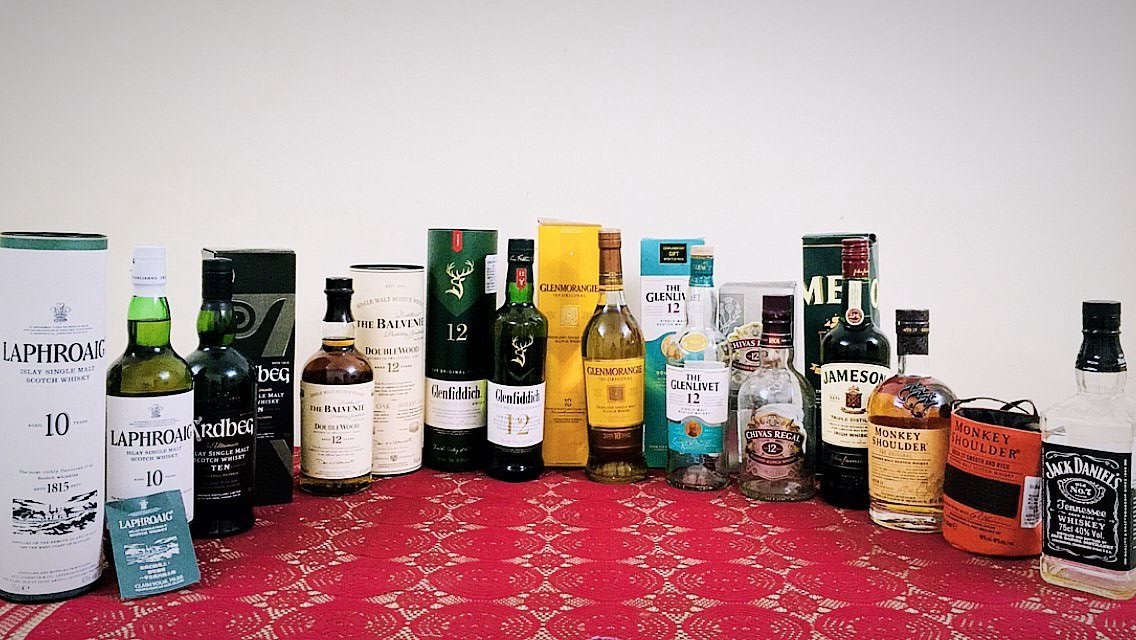
Old Scotch-heavy cabinet meeting at home. Attendance: representative, never exhaustive.
Islay was the glorious exception proving I never feared difficult flavour.
Peat smoke, brine, seaweed and Atlantic medicine sound like a maritime hospital report; in the glass they become Lagavulin’s slow fire, Laphroaig’s coastal slap and Ardbeg’s complexity. Speyside offered fruit and diplomacy. Islay brought an argument and won.
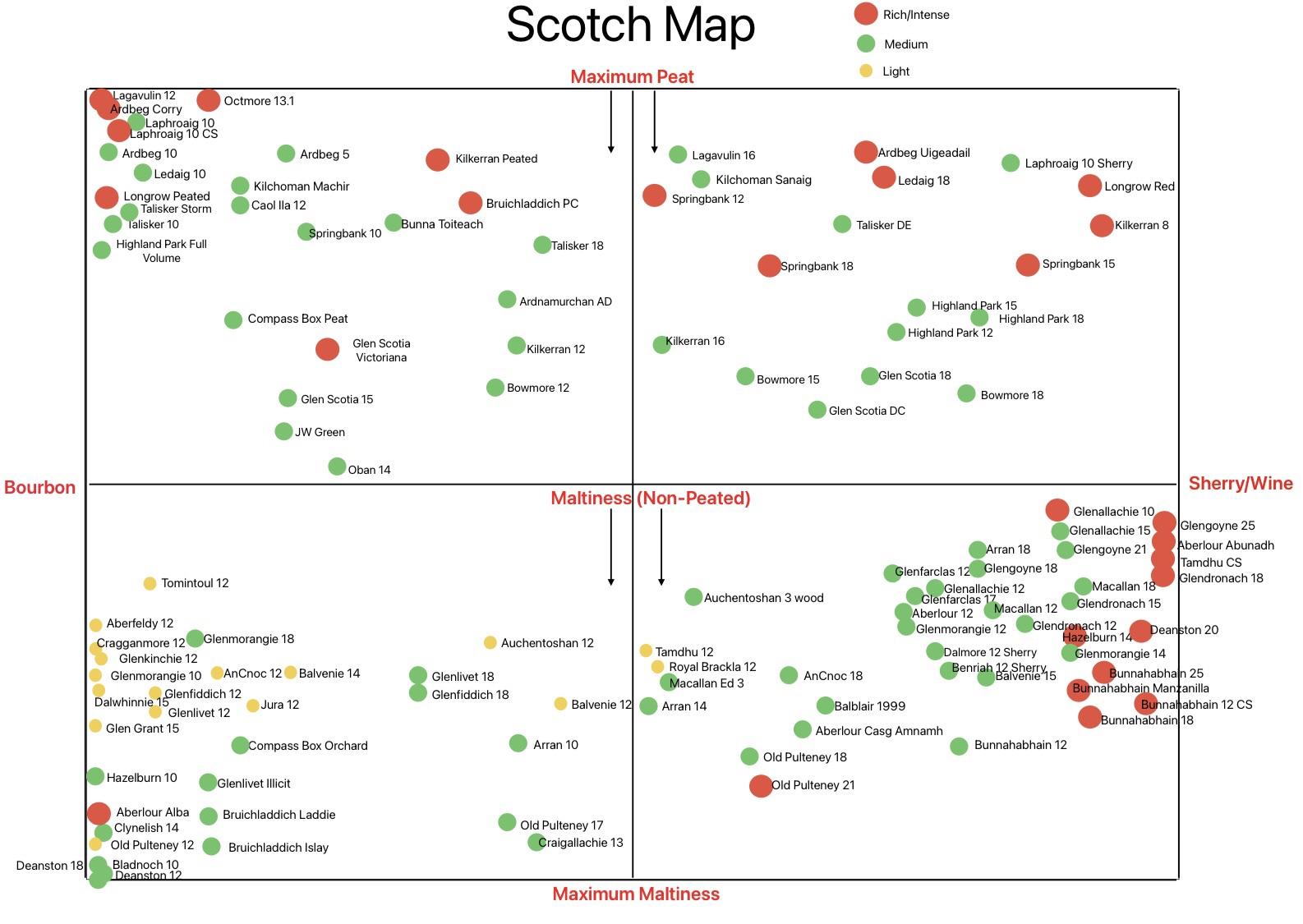
A useful compass for my Scotch detours-Islay naturally gathers near maximum peat. [Scotch Flavor Map 2.0 by u/Shoddy_Ad7511, courtesy of r/Scotch]
Irish whiskey remains underrated because it arrives without a peat fog machine or age-statement sermon. Triple-distilled, smooth and diplomatic, Jameson shakes hands with everyone and lets dinner continue. Scotch purists may scoff, but quiet is not the absence of character. Irish is quietly formidable.
I liked genuine imported Scotch, vodka, gin and wine. I also liked drinks rooted closer to Indian soil: Goa’s seasonal Urrak and Feni, Himachal’s Lugdi, and, on the right evening, desi santra. My palate was not timid. It was nosy.
Nor was I a blind disciple of expensive Scotch. Scotch is not overrated; it is worshipped too much. An age statement tells me how long a spirit waited, not whether I will enjoy the conversation. A famous label is not a flavour note. My buying rule became simple: I’ll pay for barrels that sing, not labels that shout.
I had given whisky origins, casks, smoke and value-per-rupee serious attention. Bier got no such hearing. It received a childhood verdict, one word long, and no appeal.
Wine got homework and field trips
Wine received an even fairer trial. I am already studying towards the Wine & Spirit Education Trust (WSET) , French Wine Scholar® (FWS) , Italian Wine Scholar® (IWS) and German Wine Scholar® (GWS) paths. I added GWS in 2026, when classroom providers were beginning to offer it; the independent online programme had become available in late 2025.
भारत में दारू पीओ तो मोहल्ले का verdict अक्सर cork खुलने से पहले आ जाता है: “पीकर घर, पैसा और परिवार बर्बाद करेगा।” मैं यह script बदलने वाला हूँ-घर और परिवार सलामत रहेंगे; पैसा चार wine certifications और एक suspiciously detailed tasting map बनकर लौटेगा.
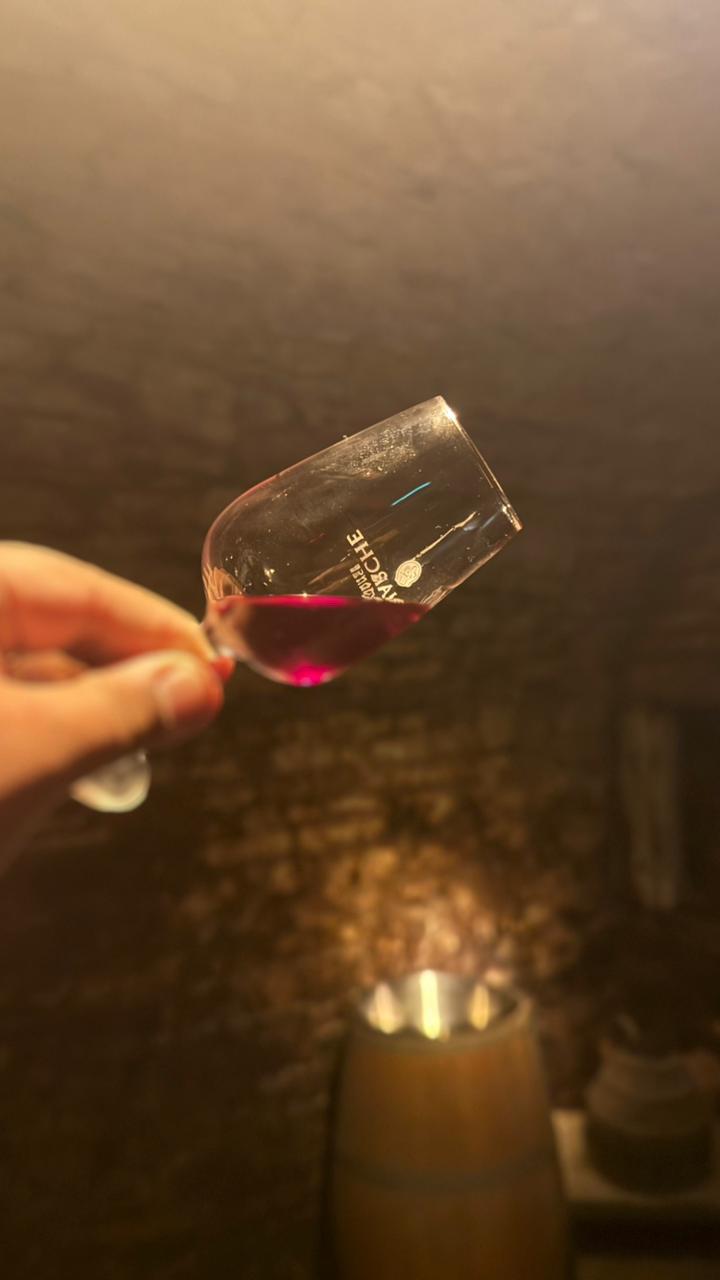
Wine had homework, field trips and cellar glasses-not merely postcards.
That curiosity escaped the classroom. France & Paris was not merely France & Paris. They became the sensible place to taste Sylvain Pataille’s Marsannay Rouge before going to Beaune, and Bernard Baudry’s Chinon Les Granges before going to Saumur. Reims, Beaune and Saumur formed a Champagne-Burgundy-Loire triangle: Taittinger and Pommery, the Cité des Climats and Patriarche, Bouvet-Ladubay and Ackerman.
The point was education, not postcards. Taste at the table, learn the vocabulary, then visit the landscape that made it.
That order matters to me. A bottle before a journey creates questions: Why does Marsannay feel different from the grander Burgundy names? What is Cabernet Franc doing in Chinon? What changes when Champagne moves from a supermarket label to chalk cellars in Reims? The visit then answers with soil, climate, method and people. A photograph can prove I stood somewhere. A tasting note can prove I paid attention.
Whisky had a map. Wine had a syllabus and field trips. Bier alone remained in quarantine.
Bier alone remained in quarantine
My early beer encounters in India felt like choosing between one strong mass-market lager and another. I did not taste barley, bread, yeast, citrus or place. I tasted cold, harsh bitterness and a culture that often sold the “kick” before the craft. Being told I would learn to tolerate it was not a convincing sales pitch, boss.
There are concrete reasons for distrust. In January 2024, FSSAI and Customs seized 45 metric tonnes of expired beer , worth roughly ₹1 crore, from a bonded Delhi warehouse. FSSAI called the stock a clear violation; it did not say that it had reached consumers or prove that beer across India was chemically adulterated.
A 2024 Comptroller and Auditor General audit of Delhi liquor regulation found mandatory microbiological reports in only six of 31 domestic beer-brand registrations it examined, while 40 of 51 foreign-beer registrations examined lacked microbiological testing. It also found annual quality certificates for five named Carlsberg and Tuborg beers that appeared identical except for altered report and batch numbers. The CAG called those certificates unreliable and recommended forensic examination.
That proves control failures and suspect paperwork, not an unknown substance in every bottle.
From late June 2026, enforcement became harder to dismiss as an occasional headline. Maharashtra FDA seized about 1.5 tonnes of expired, damaged and spoiled food from Bhiwandi warehouses, sealed a facility and suspended its licence. Officials said eight earlier raids had uncovered more than ₹45 lakh in unsafe products. This was food-supply enforcement, not beer evidence; its relevance is the scrutiny of storage, destruction records and alleged recirculation.
The alcohol evidence then became more direct. Notices went out from 10 July, and on 2 August FSSAI published its official position on non-permitted flavours and age claims . Laboratory reports found sampled rum and whisky products substandard because external flavours imitated the character of standardised drinks. FSSAI named manufacturers, challenged age claims, prohibited several sales and recorded further inspections and notices. This is laboratory-backed evidence-not gossip-but it concerns spirits, not beer, and FSSAI said it did not represent the entire industry.
Expired beer, weak beer-testing controls, mishandled food stock and artificially flavoured spirits are related reasons for caution, but they are not the same offence. Throwing them into one scary headline would be exactly the sloppy reasoning I disliked in the market.
The market structure still explains part of my experience. Strong lager at 6-8% ABV represented more than 80% of Indian beer consumption , and three producers held roughly four-fifths of the market. Heat and sunlight can also damage perfectly legitimate beer in transport or storage. Community complaints about harshness, odd bottle-to-can differences or beer tasting like “dishwater” are useful signals, but Reddit is not a food laboratory.
There is a correction on the optimistic side too: India now has a growing craft-beer culture that is wider than the lager shelf I knew. My instinct that quality control and sameness deserved scrutiny was not foolish. My decision to quarantine the whole category was.
Two days before my birthday, the model broke
On 10 July 2026, two days before my birthday, Spain played Belgium in a World Cup quarter-final. My local German friends Johann and Mario offered me a Radler-more specifically, a Natur Radler.
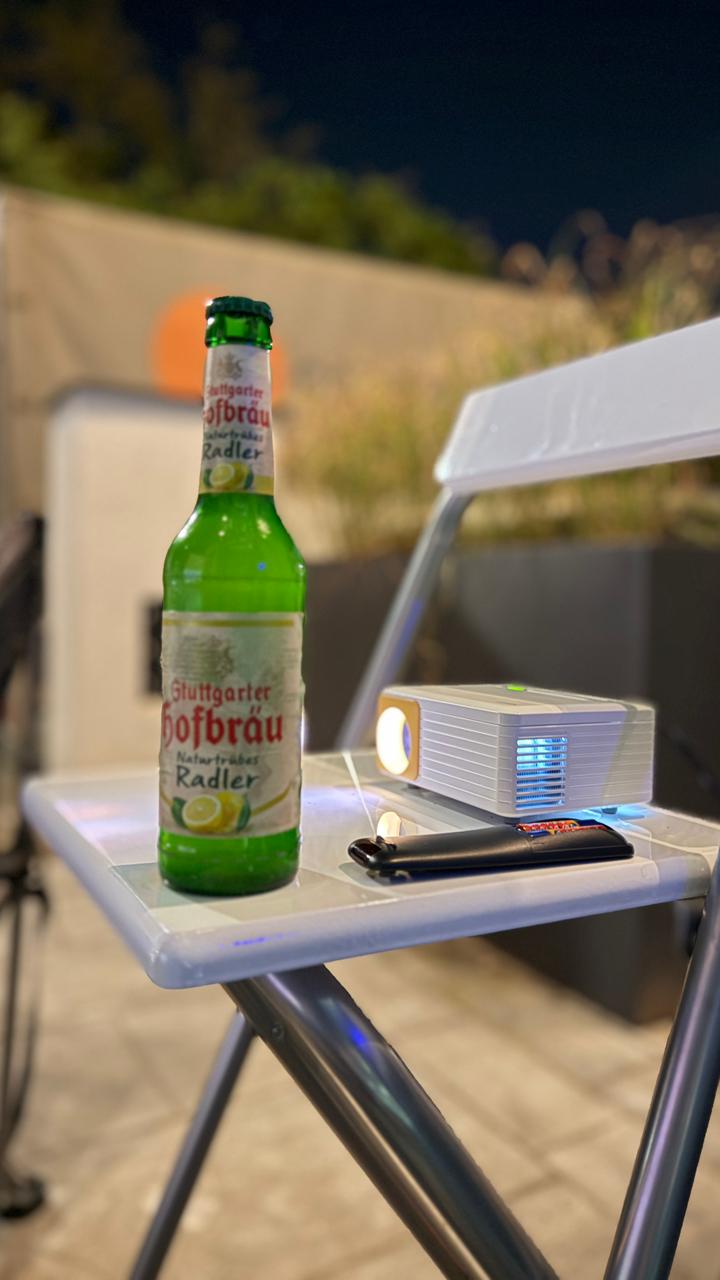
Our World Cup setup: projector, Stuttgarter Hofbräu Naturtrübes Radler, and the trouble Johann and Mario started.
“Radler” had always sounded like a compromise to people who already loved Bier. To me it was a bridge: Bier mixed with citrus lemonade, lower in alcohol, softer in bitterness and still recognisably more than fizzy lemon water. Natur mattered too. The bottle was naturtrüb-naturally cloudy rather than polished into visual obedience.
The first surprise was not that it was sweet. The surprise was that it had movement. It was spritzig: lively and sparkling. It was also süffig, that dangerously useful German compliment for something pleasant and easy to drink. Citrus opened the door; malt and Bier stayed in the room.
The Radler that became my reference was Mönchshof Natur Radler.
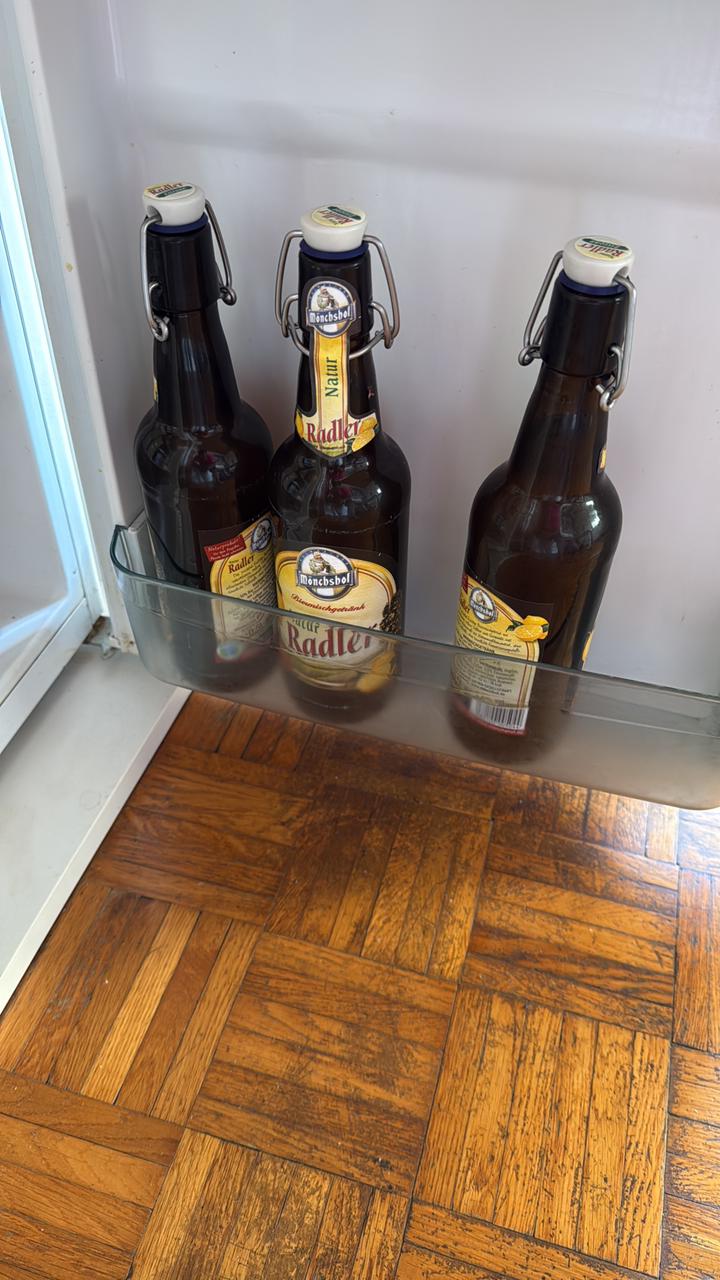
Three Mönchshof Natur Radlers: my reference was no one-bottle experiment.
Its public record supported what my palate had found: BeerTasting showed 3.67 from 2,380 ratings , while Untappd showed 3.32 from 26,028 during my audit. Those scores belong to different communities and should not be averaged as though they were two thermometers in the same room. Their sample sizes do tell me this was not merely birthday-week optimism.
One bottle made me reconsider Bier. Twenty-seven candidates made me open Excel.
Naturally, I opened a spreadsheet
The question began as “Is anything better than Mönchshof?” It quickly acquired columns.
I started with names I had tried, recommendations and a Dachtler shop list. It served only as a catalogue and delivery source, not a quality signal. I then checked official brewery pages for exact identity; BeerTasting and Untappd for rating plus sample size; Reddit, forums, blogs and articles for recurring praise or complaints; and Stuttgart-area shops for realistic prices.
The order mattered:
- Exact product first. A brewery’s Pils, Weizen or alcohol-free bottle does not prove that its Natur Radler is available.
- Score with sample size. A 3.8 from 40 drinkers and a 3.5 from 50,000 describe different kinds of confidence.
- Sentiment as explanation. Community comments can reveal sweetness, citrus balance or metallic impressions; they cannot turn one bottle into a universal defect.
- Store-list availability by exact SKU. A product counted only when the named mix itself appeared on the shop’s list.
- Price by litre, excluding Pfand. A 24×0.33-litre Kiste and a 20×0.5-litre Kasten are not equal because English calls both a crate. Refundable Pfand is not Bier cost.
I checked EDEKA, REWE, Lidl, Netto, Penny, Kaufland, HIT, specialist Getränkemärkte and delivery services around Stuttgart. Ratings are entertaining. Kistenschleppen-hauling a crate of glass upstairs-is less so. Convenience belongs in the decision even when it does not belong in the Bier score.
What the complete audit found
My personal four: three classical Natur Radlers, then one grapefruit-Weizenbier specialty.
| Rank | Natur Radler | Why it stays here | Buying logic |
|---|---|---|---|
| 1 | Mönchshof Natur Radler | My proven reference; huge review base; lemon-forward but with enough Bier beneath it | Restock at €12.99-13.99 for 20×0.5 L at EDEKA or REWE |
| 2 | Hochdorfer NaturRadler | Strong on both rating platforms and the best locally deliverable classical contender | Local delivery: €23 for 24×0.33 L, excluding Pfand |
| 3 | Gösser NaturRadler | The broadest positive public consensus among the leaders | Try a promo can first; buy a crate around €14.99-16.99 |
| 4 | Schöfferhofer Grapefruit | My grapefruit-Weizenbier bridge into Level 2 | Local delivery: €23 for 24×0.33 L, excluding Pfand |
This is not an objective podium. Gösser’s 54,000-plus Untappd ratings give it the largest public consensus; Hochdorfer’s paired results make it the strongest top-three delivery choice. Mönchshof remains number one because the question began with my glass, not an algorithm. Schöfferhofer is Personal #4 across styles.
Three newcomers earned immediate trials: Gruibinger Halb/Halb Zitrone, the best discovery in the store list and a 2025 European Beer Star silver medallist; Rothaus Natur Radler Limettenzäpfle, a well-supported lemon-lime option; and Schönbuch Naturpark Radler, a locally relevant contender whose larger Untappd sample reinforces its promising small BeerTasting result.
The field became useful once I stopped demanding one winner. Hacker-Pschorr and Paulaner are dependable; Licher is good; Schussenrieder is promising but under-reviewed. Fürstenberg, Stuttgarter Hofbräu, Berliner Kindl, Schwaben Bräu and Kloster Metzingen form a sensible middle. Dinkelacker may suit a more Bier-led palate. Warsteiner ranks lower, but lower is not faulty.
Welde and Lösch-Zwerg stay in the exploration tier. Waldhorn is the value experiment: €15 for 20×0.5 L delivered. It is not an online mystery after all-its tiny review samples exist and are merely average. Personal #4 * Schöfferhofer Grapefruit* and Zwiefalter Radler Sauer remain specialties, not distorted entries in a classical sweet-lemon ranking. One is a Weizenbier and grapefruit mix; the other is Bier with soda water, unsweetened.
Complete alcoholic ledger: 20 classical Radlers plus two specialties
| Tier | Product | Evidence snapshot | Exact on shop list? |
|---|---|---|---|
| Personal #1 | Mönchshof Natur Radler | BT 3.67/2,380; UT 3.32/26,028 | No |
| Personal #2 | Hochdorfer NaturRadler | BT 3.85/288; UT 3.55/3,030 | Yes |
| Personal #3 | Gösser NaturRadler | UT 3.60/54,186; BT brewery 3.87/6,356 | No |
| Personal #4 · Grapefruit specialty | Schöfferhofer Grapefruit | BT 3.44/1,726; UT 3.58/183,088 | Yes |
| Shortlist | Gruibinger Halb/Halb Zitrone | BT 3.48/47; European Beer Star silver 2025 | Yes |
| Shortlist | Rothaus Natur Radler Limettenzäpfle | UT 3.49/about 1,423 | Yes |
| Shortlist | Schönbuch Naturpark Radler | BT 3.69/72; UT 3.45/1,365 | Yes |
| Explore | Welde Natur Radler | UT 3.53/3,607 | No |
| Explore | Lösch-Zwerg Natur Radler | BT 3.57/566 | No |
| Good | Hacker-Pschorr Natur Radler | BT brewery 3.47/2,061; UT 3.31/13,052 | Yes |
| Good | Paulaner Natur Radler | BT 3.44/888; UT 3.36/about 17,300 | Yes |
| Good | Licher Natur Radler | BT brewery 3.67; UT 3.33/2,714 | No |
| Good, low sample | Schussenrieder Natur Radler | BT 3.57/89 | No |
| Solid | Fürstenberg Natur Radler | BT brewery 3.50/436; UT 3.25/3,333 | No |
| Solid | Stuttgarter Hofbräu Naturtrübes Radler | BT 3.41/251; UT 3.22/2,771 | Yes |
| Solid | Berliner Kindl Berliner Radler Naturtrüb | BT 3.33/244 | No |
| Solid | Schwaben Bräu NaturRadler | UT 3.25/2,342 | Yes |
| Solid | Kloster Natur Radler | BT 3.25/111; UT 3.23/1,050 | No |
| Value experiment | Dinkelacker Naturradler | BT 3.33/81; UT 3.10/1,754 | Yes |
| Value experiment | Waldhorn NaturRadler | BT brewery 3.26/34; UT 3.11/28 | Yes |
| Lower evidence rank | Warsteiner NaturRadler Zitrone | BT brewery 3.20/843; UT 3.22/5,819 | No |
| Unsweetened specialty | Zwiefalter Radler Sauer | Listing 2.57/149; niche style | Yes |
Alcohol-free Radlers needed their own grid. A different recipe cannot inherit the reputation of its alcoholic sibling, and alkoholfrei can allow a small residual amount unless the label explicitly says 0.0%.
| AF rank | Product | Evidence-based reading | Exact on shop list? |
|---|---|---|---|
| 1 | Mönchshof Natur Radler 0.0% | Best match for my known preference; strong sample and true 0.0 positioning | No |
| 2 | Gösser NaturRadler 0.0% Zitrone | Strongest broad alternative | No |
| 3 | Hochdorfer NaturRadler Alkoholfrei | Worth a trial, though public evidence is mixed and delivery is expensive | Yes |
| 4 | Welde Natur Radler Alkoholfrei | Credible exploration candidate with several hundred ratings | No |
| 5 | Hacker-Pschorr Radler Alkoholfrei | Best-supported conventional local-delivery value in the upper group | Yes |
Complete alcohol-free ledger and exact shop-list matches
| AF rank | Product | Evidence snapshot | Exact on shop list? |
|---|---|---|---|
| 1 | Mönchshof Natur Radler 0.0% | BT 3.44/902; UT 3.23/6,173 | No |
| 2 | Gösser NaturRadler 0.0% Zitrone | BT brewery 3.43/1,639; UT 3.33 | No |
| 3 | Hochdorfer NaturRadler Alkoholfrei | BT 3.46/105; UT 3.05/355 | Yes-€26, 24×0.33 L |
| 4 | Welde Natur Radler Alkoholfrei | UT 3.26/602 | No |
| 5 | Hacker-Pschorr Radler Alkoholfrei | BT brewery 3.34/351; UT 3.26/1,961 | Yes-€23, 20×0.5 L |
| 6 | Licher Natur Radler Alkoholfrei | UT 3.16/905 | No |
| 7 | Schwaben Bräu Das Naturradler Alkoholfrei | UT 3.23/25 | Yes-€19.50, 24×0.33 L |
| 8 | Paulaner Natur Radler Alkoholfrei | BT 3.32/189 | No exact SKU |
| 9 | Krombacher Radler Alkoholfrei | BT 3.15/838; UT 2.94/9,065 | Yes-€12, 11×0.5 L |
| 10 | Alpirsbacher Radler Naturtrüb 0.0% | UT brewery 2.94/1,903 | Yes-€25, 24×0.33 L |
| Specialty | Schöfferhofer Grapefruit Alkoholfrei | BT 3.19/692; UT 2.96/4,505 | Yes-€23, 24×0.33 L |
The shop list yielded 18 exact mixes: 12 alcoholic and six alcohol-free. The alcoholic matches are Waldhorn, Dinkelacker, Stuttgarter Hofbräu, Paulaner, Hacker-Pschorr, Schwaben Bräu, Zwiefalter Sauer, Rothaus, Schönbuch, Hochdorfer, Schöfferhofer Grapefruit and Gruibinger. The six alcohol-free matches are Krombacher, Hacker-Pschorr, Schwaben Bräu, Schöfferhofer Grapefruit, Alpirsbacher and Hochdorfer.
The delivery ledger also explains why pack size can mislead. Among alcoholic matches, the litre price runs from Waldhorn at €1.50/L through Stuttgarter Hofbräu and Dinkelacker at €1.90/L, then Paulaner at €2.20/L and Hacker-Pschorr at €2.30/L. The 0.33-litre cases climb towards Hochdorfer and Schöfferhofer at €2.90/L, with Gruibinger at €3.41/L. I may still choose the expensive case, but now I know whether I am paying for preference, a small bottle format or somebody carrying the Kiste upstairs.
The audit also removed a few good stories that happened not to be true:
- Waldhorn was not unreviewed; it had small, average samples.
- One metallic-taste remark did not justify calling Warsteiner an “avoid.” That verdict is retracted.
- Stuttgarter Hofbräu Naturtrübes Radler had been confused with an older, different variant. The exact product is a respectable local-value option.
- The shop list’s Fürstenberg Pilsener, Lösch-Zwerg Würzig, Schussenrieder Spezial/Helles, Warsteiner Pilsener and Berliner Weisse are not matches for the named Radlers.
- Praise for alcoholic Krombacher or Alpirsbacher could not be pasted onto their alcohol-free delivery listings.
The spreadsheet did not make taste objective. It made my uncertainty visible.
Stuttgart is phase one, not the finish line
For now, the buying logic is practical. Mönchshof at €12.99-13.99 for 20×0.5 L at EDEKA or REWE is a restock. A €0.79 Gösser can at Penny is a cheap audition; a €14.99-16.99 crate at Kaufland is the promotion to watch. Rothaus at HIT for €14.99 per 24×0.33 L beats the store-list price of €22 when the exact product is in stock. Hochdorfer at €23 delivered carries a convenience premium I will pay. Waldhorn at €15 delivered is science on a budget.
Stuttgart is phase one. I plan to extend the map across Deutschland and Österreich: regional breweries, supermarkets, Getränkemärkte, Biergärten and Austrian Gasthäuser. There I will also need the ordering vocabulary. A Seidl is commonly about 0.3 L; a Krügerl about 0.5 L. If a discovery is genuinely excellent, eastern Austrian slang permits one carefully earned leiwand.
The tasting ladder now points across Germany and Austria
This now works like my wine and whisky plans: keep one thing familiar, change one variable, taste, note, stop. It is my route, not a universal prescription.
Level 1: establish my Radler baseline
- Mönchshof Natur Radler - my known reference.
- Hochdorfer NaturRadler - my locally deliverable contender.
- Gösser NaturRadler - the large-consensus test.
- Rothaus Natur Radler Limettenzäpfle - familiar structure, sharper lemon-lime direction.
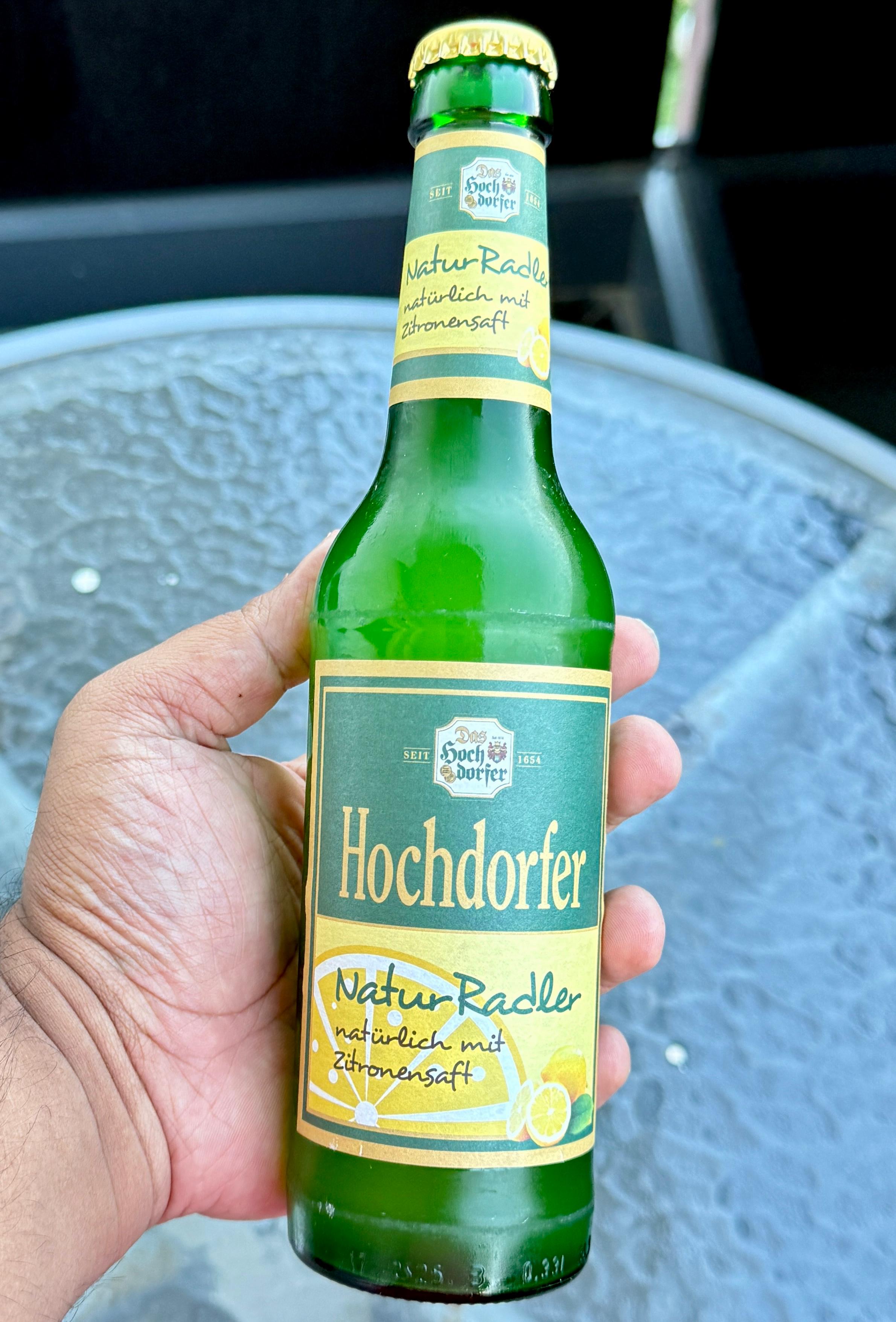
Hochdorfer NaturRadler has arrived—and Mönchshof might want to check whether its crown is still secure.
Level 2: change one support at a time I am here; level almost complete
- Stiegl Grapefruit versus Stiegl Zitrone , side by side-both 40% Goldbräu, 60% lemonade; only citrus changes.
- Schöfferhofer Grapefruit - grapefruit over a Weizenbier base.
- Freshly mixed Saurer Radler - Bier and Soda-at an Austrian Gasthaus: sugar goes; dilution stays.
Level 3: remove the lemonade
- Weihenstephaner Hefeweissbier -banana, clove, bread and a gentle 14 IBU.
- Franziskaner Dunkel Weissbier-keep wheat and yeast; introduce toast and caramel.
- Stiegl-Goldbräu -taste the actual Bier beneath both Stiegl Radlers.
- Augustiner Hell vom Fass -my clean, malt-led German field test.
Paulaner Hefeweizen is an optional A/B; Gösser Märzen an optional Austrian comparison. Kellerbier waits. Pils comes when bitterness becomes a variable, not punishment.
One non-negotiable field test
A German Bier journey should not remain trapped in supermarket tables.
My venue test is Augustiner Biergarten Stuttgart : an Augustiner Hell vom Fass, 0.5 L before I make heroic Maß decisions.
Note
My first note said about €4.90 for 0.5 L and €9.60 for a Maß. The current official menu lists €5.20 and €10.20. This is why prices need dates.
Draft Helles tests what bottles and rating sites cannot: freshness, service, food, weather, company and whether Bier makes sense when it is allowed to be itself. Johann and Mario should probably be there. They started this trouble.
What changed
Natur Radler did not make me love every Bier. Good. That would be one lazy generalisation replacing another.
It made me give Bier the curiosity, discipline and fair trial I had already given whisky, gin and wine. The whisky cartographer who tracked Goa against Delhi, the wine student who wanted Marsannay before Beaune, and the Bier sceptic who said बीयर कड़वी है were always the same person. Bier simply needed the right entrance.
Mönchshof opened it. Hochdorfer and Gösser made it worth mapping. Gruibinger, Rothaus and Schönbuch supplied the next coordinates. Stuttgart supplied the first buying rules; Germany and Austria will supply the fieldwork.
Maybe taste can be acquired. Sequence still matters. You do not teach someone music by beginning with the loudest speaker in the shop. You find the sound that makes them curious, then let curiosity do the work.
Two days before my birthday, Johann and Mario handed me something cloudy, lemony and suspiciously süffig. I called it a Radler. My spreadsheet called it the beginning of a much larger problem. Prost.
TL;DR
- I avoided Bier-not alcohol-after early encounters reduced it to kadva-कड़वा / bitter / erbittert.
- On 10 July 2026, Johann and Mario reopened Bier for me. Thank you-I truly appreciate you both. Danke-ich schätze euch beide sehr.
- Indian enforcement found expired stock and weak controls-not proof that every Indian beer is adulterated.
- My personal alcoholic top four are Mönchshof, Hochdorfer, Gösser and Schöfferhofer Grapefruit; number four is deliberately a specialty.
- Alcohol-free Radlers have a separate ranking; the store list contains 18 exact mixes, compared by SKU and €/L.
- I am almost through Level 2; next come Weissbier, draft Helles and regional Bier across Deutschland and Österreich.
- Prost.🍻
